What is it about Belgium?

Belgians might sum up their country’s national identity by saying: “It’s complicated.”

This country appealed to me because of the cultural duality I saw in its tennis stars, Kim Clijsters and Justine Henin. They represented Belgium as Fed Cup teammates, but were not friends. These two tennis competitors mirrored their country’s competing regions. That bit of intrigue, and the fact that relatively few Americans travel there, is why I wanted to go.

I spent two weeks in Belgium in 2007; and three days there in 2015 with my local friend, Mollie. Even Belgians wanted to know “Why Belgium?” No one could understand how I could spend an entire two weeks in the country.  To put it in perspective, Belgium is about the size of Maryland. I can’t imagine traveling in Maryland for two weeks and being as enthralled. So, what is it about Belgium?
Belgium map from Insight Guides Belgium

Map from Insight Guides – Belgium

I’ve seen Brussels described in news articles as a second-tier European capitol, which means the rest of the country is probably held in the same regard.  Belgium’s cities, though, have been major financial centers throughout the centuries. For instance, in the 17th century, Ghent, in Flanders, was the second largest city in Europe after Paris.  Liège, in Wallonia, was a major producer of steel during the Industrial Revolution. Now, the European Union (EU) is headquartered in Brussels, which is known as the Capital of the EU.

Did you know…

  • Dutch-speaking Belgium is known as Flanders; and French-speaking Belgium is known as Wallonia. These two regions are culturally, economically, and politically different, and sometimes at odds with each other. Cultivating a single national identity is a challenge.
  • Ancient cities, Tongeren and Tournai (in Flanders and Wallonia, respectively) were part of Roman Belgium (or Gallia Belgica) in 27 B.C.  Earliest reference to Brussels is around 960 A.D., known then as “Bruocsella.”
  • The “Flemish Painters”  — Sir Peter Paul Rubens and Sir Anthony Van Dyck and others — flourished in the Baroque tradition in the 17th century. (Don’t confuse them, though, with the “Dutch Masters.” That group includes Vermeer and Rembrandt.) René Magritte was a famous Belgian surrealist of the 20th century.
  • There is a saying about “meeting one’s Waterloo.” Waterloo, just south of Brussels,  is where Napoleon finally got his little arse kicked by a combination of British, Dutch, and German forces back in 1815.
  • Portions of what is now Belgium were controlled at different times by the Romans, the Spanish, and the French. Belgium was part of The United Kingdom of the Netherlands until 1830 when it gained independence (and its own monarchy) under King Leopold I. Though younger than the U.S. as a nation, some of Belgium’s cities and villages date back a millennium.
  • Belgium is bordered by France, The Netherlands, Luxembourg, and Germany. Its official languages are French, Dutch, and German. Brussels is a mandated bilingual (French and Dutch) city and province.
  • Belgium was invaded twice by Germany in World Wars I and II. The Second Battle of Ypres inspired the famous poem “In Flanders Fields.”
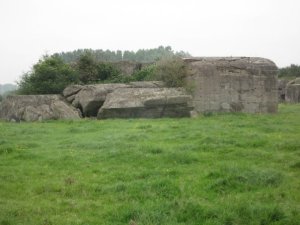
German WW II bunker - Flanders, Belgium

Remnants of German Bunker – Flanders

Poppies in a field - Flanders

Poppies in a field – Flanders

  • Belgium’s regions are mostly politically autonomous and the government is de-centralized. Amazingly, Belgium went 541 days without an elected government from 2009-11.
  • Belgium currently has the third most robust economy in the EU.
  • Flanders has a fierce lion on its flag; Wallonia has a cock (male rooster!) on its flag; and the national flag of Belgium is identical to the German flag in colors — the only difference being vertical versus horizontal stripes.
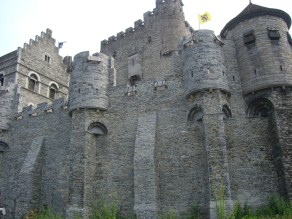
Gravensteen Castle with the Flemish flag

Gravensteen Castle – Ghent – Flemish flag above
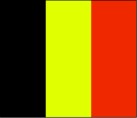
belgiumflag copyRooster - Ghent 2

What is it about the Belgian brand?  For food that has been exported world-wide, there’s Belgian endive, Belgian waffles, Brussels sprouts, Belgian chocolate, and Belgian beer and ale.  People have made a pilgrimage to Belgium for the beer and ale alone.
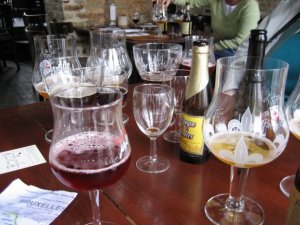
Belgian beer-tasting

Beer-tasting in Flanders

Even some dog breeds rate a Belgian brand, like the Belgian shepherd, Bouvier des Flandres, and the very interesting-looking Griffon Bruxellois. Maybe, just maybe, a Belgian brand means Belgium has a national identity after all.

Belgium is a diverse country. When I was there in 2007, I was struck by the number of Muslims and Africans living there. In the 1860s, Belgium became a colonial power when it stole the Congo (now known as the Democratic Republic of Congo).  The exploitation continued until the mid-1950s.  Belgium also controlled a territory, formerly known as Ruanda-Urundi, and now known as the Independent Kingdoms of Rwanda and Burundi. Hence, the African populations in Belgium from the Congo, Rwanda, and Burundi.

I wondered when and why Muslims migrated to Belgium. In the 1960s, the first wave of migrants came from Morocco and Turkey. They were in Belgium on guest worker passes. Later, these migrants were followed by those from Algeria and Tunisia. Muslim populations in Brussels and Antwerp are comparable in size to those in Marseilles and Paris.

From my observations, North African Muslims and Africans did not appear to be thriving or part of mainstream Belgian society. I thought the same thing about Paris back in 1998, and recently in 2015. But, I was just passing through, so what did I know? Since then, I’ve learned my observations were on point. As an African-American, I have radar for this sort of thing.

What is it about Belgium? Why do people from these groups still come? Linguistically, Belgium works for native French and Dutch-speakers from anywhere in the world. And Belgium’s “balance sheet” is very much in the black. Migration generally occurs in the direction of opportunity. The question is whether everyone can partake in opportunities.

After the Brussels terrorist attacks on March 22, 2016, media outlets seemed to focus on Belgian authorities as being a bunch of boobs. That the Belgian government is mired in incompetence. That Brussels is an incubator for jihadists. That the EU is a failure when it comes to communicating intelligence to its member states. That Belgian nationals were among the Paris terrorists, and it’s Belgium’s fault because they were radicalized there. Any iota of sympathy for loss of lives and property in the Brussels attacks was overwhelmed by the recriminations.

What is it about Belgium? The public response toward Brussels was not like it was toward Paris when it was attacked in January and November 2015. Did someone press the mute button on the sympathy response? Where was the Belgian flag overlay for the Facebook profile photos?  Some people think it’s because Belgium is not as well known as France.

Shortly after the Paris attacks, I wrote this piece. It applies to Belgium’s tragedy from jihadist attacks, too.  Mollie was on her way to work when she was turned away at the Métro station and sent home. The Métro had already been attacked. In Mollie’s words, “the fear is palpable.” Belgium’s predicament has been ours, too. Terrorism occurs all over the world.

What is it about Belgium? Tiny and complicated though it is, Belgium is an historical treasure, and a major player in contemporary European politics. Without a doubt, Belgium and the EU have particular challenges.  I’ll give Belgium a moment or two to regroup before I travel there again…and I certainly will.

Logo bigger final


Paris: Eating Like a Local

I’ve been thinking about my trip to Europe last October because my sister, Cheryl, will be traveling there soon. We’ve talked about how food is a major part of the travel experience. And we definitely love food.  What does it mean to “eat like a local”? It can mean eating where locals eat; eating the way locals eat (with locally-used utensils or hands) and even eating at the time of day locals eat.

Of the three European cities I traveled to, I spent the most time in Paris. I love French food, but my diet has changed over the past eight years. No béchamel sauce, crêpes, croissants, pastries, and baguettes for me. So I thought. But, I also figured I could navigate my little food quirks, even in Paris.

The French take their entire culture — language, art, music, wine, and food, very seriously. They are clear about what it means to be French. France has a Minister of Culture presiding over touchstones of French identity and French contributions to the arts. French words pertaining to food, like restaurantgourmet, café, connoisseur, and cuisine are commonly used in English language.

French cuisine has always been a gold standard for trained chefs; and I have read that the cuisine is in crisis.  So what does that mean? Food at an authentic-looking bistro may have been previously frozen, perhaps pre-assembled, and not totally prepared in-house with raw ingredients. Read about it here.

(Good lord…that sounds like American restaurant chains! I didn’t have to leave home for that!)

So, with that awareness, I decided to be discriminating about where I would eat in Paris, same as I am here. I would not eat at bistros with burgers and pizza on the menu. I can get that food here (if I were so inclined — which I am not). But, then again, when you’re fresh off the plane and it’s lunch time, you might just bust those standards and eat anywhere. People who know me know that I go from very hungry to “hangry” fast.

I found Bistrot La Bonne Cécile a mere two blocks from my Airbnb and ate lunch there. The menu is rotated seasonally. The restaurant served fresh food made in-house. I could not have been more delighted with my first meal on the Continent, and glass of Sancerre. The restaurant was charming and the service was exceptional. (Tip: you do not tip in France.)

Soup course - La Bonne Cecile - Paris

Soup course – La Bonne Cecile – Paris

Entree seafood pot and rice - La Bonne Cecile - Paris

Seafood pot and rice – La Bonne Cecile – Paris

Coffee is big in Paris, but I don’t drink it. I indulged, instead, in chocolat chaud (hot chocolate) made with milk and cream. Made right, it’s oh-so-rich. I’m lactose intolerant and didn’t get a stomach ache from drinking it!  Best cups are made with chocolate, not cocoa powder. As noted in this blog, using a powder instead of a high-quality chocolate bar with its rich cocoa butter, is really hot cocoa and not hot chocolate.

Paris has an abundance of ethnic restaurants. I enjoyed them, too. I also had great meals at very casual restaurants. One of them was Le Pain Quotidien. My friend, Charlotte, asked me to meet her there. We have one in D.C. — that I’d never been to — and I didn’t expect to go to that chain in Paris. Well, it was a cut above and delicious! I had a great salad, gluten-free bread, and a bowl of soup. I’ve since been to Le Pain Quotidien in D.C.

Some other casual restaurants in Paris:

Divin’ Art, near Arts et Metiers Metro, is a gluten-free crêperie in walking distance of my Airbnb. I ate a savory crêpe (smoked salmon, soft-boiled egg, and peppers), carrot soup, green salad, and a chocolate crêpe.

Savory gluten-free crepe - Divin Art

Gluten-free crepe from Divin’ Art in Paris (Marais)

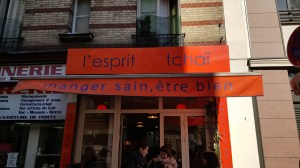
While walking in search of Paris’ street art in the Oberkampf neighborhood, I found this vegetarian and gluten-free restaurant. I had a fresh juice, carrot soup, and a vegetable rice and almond dish. Simple, healthy, and delicious. And the meal was cheap!

Vegetarian gluten-free in Paris

L’esprit Tchaï – Paris

Rice and vegetables

I also ate food that was a little out of my comfort zone. The complete meal here was the salade niςoise and escargot, with a glass of white wine.

Salade nicoise

Salade nicoise with anchovies

Eating escargot was a challenge. I eat escargot because they are a super-beneficial food for my blood type. I take an almost medicinal view toward it.  I don’t go into a swoon over the taste, but escargot is more than just palatable. The challenge was dealing with the little animal in its shell, which was a first for me. The escargot I’ve eaten has always been hidden — thankfully, because they are rather ugly — under a garlic, parsley and butter sauce in a snail plate. No shells included.  But, I had on my big girl panties and would eat escargot like the French.

I asked the server to show me how to use the snail tongs. First, you grip the shell, which is when I had the Pretty Woman moment. The shells are indeed “slippery little suckers,” but at least they didn’t go flying across the room. Next, you use the little fork to pull the critter out. After an embarrassing struggle, I managed to grip three shells and pull out three escargot. I couldn’t get the last two out of their shells.  As far as I was concerned, no one was home. The server was watching me, so I asked him to try. I wish I’d taken a video of him trying to find the snails. He probably thought it was just me. He gave up, too, and put in an order to replace the two snails that had gone missing.

Escargot

Escargots

See this video for how to eat escargot.

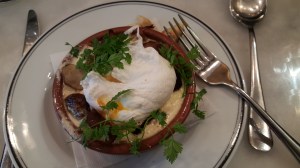
Another outside-the-comfort-zone food was this dish of wild mushrooms (chanterelles, porcini, and parasol) and poached egg.  I don’t like poached eggs, but I gave this dish a go.  It was a work of art, interesting and tasty. The restaurant, La Mazenay, was lovely; and the service was meh.

Le Mazenay - wild mushrooms and poached egg

A highlight was lunch with Charlotte at elegant Bofinger’s near Place de la Bastille.  I had this delicious fish and vegetable dish.

Fish and vegetables in sauce - Bofinger's

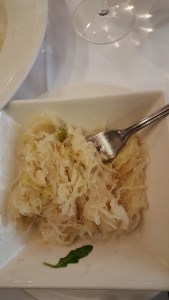
I also ate this dish of sauerkraut, or choucroute. It was not part of my order. It came from the table of diners next to ours. I was eye-ballin’ their sauerkraut because they weren’t eating it, and it looked good. They were eating the pork all around it instead. Charlotte asked the diners if I could have a taste. That was a little tacky, I know, but I guess they decided to help the American out.

Choucroute

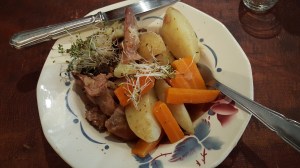
Another food that is not everyday fare in the U.S. is  rabbit, or lapin. I had this very tasty rabbit and prune stew at Le Pichin 3 — a family-owned restaurant in the City of Chartres near the Cathedral. Damn, it was good!

Lapins at the market

Lapin at the market before one was turned into stew

rabbit and prune stew at le pichet 3

Rabbit and prune stew at Le Pichet 3

In addition to chocolat chaud, I enjoyed two other kinds of sweets:

Macarons — looking like colorful little hamburgers, these gluten-free cookies made of almond flour have a flavored cream filling. They are everywhere in Paris. Quality matters. Eat enough of them and you can distinguish the mediocre from the sublime.

Macarons

Les Macarons

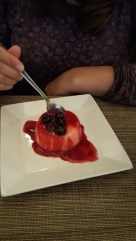
Panna Cotta — the best I’ve ever had in my life came from a tiny Italian restaurant Charlotte and I ducked into to escape the rain. This was Charlotte’s dessert. After a taste, I had to order my own. The texture was perfectly smooth, and the sweetness came from the berries and sauce.

panna cotta in Paris

Panna Cotta

My main dining event was a six-course dinner at Pierre Sang in Oberkampf. The hostess took everyone’s food restrictions and preferences. You don’t order from a menu. The six courses are the chef’s choice and everyone gets the same dish, customized as requested.  The hostess answered our questions about what we had eaten afterwards. I was fine with that. It was part of the experience. Reserve a seat at the bar so you can watch the chefs and talk with other diners, especially if you’re solo.

I was thrilled that the Pierre Sang experience was only €45. For the same price here in D.C., a diner could pay that or more for uninspired fare.

There are so many options for dining in Paris. You can dine satisfactorily or fabulously for good value in this city.  Challenge your food comfort zone when you travel, and eat like the locals!