Planes, Trains, and Vehicles: Getting Around Europe (Part 3)

Amsterdam is a two hour train ride from Brussels, and trains run frequently. I was fine buying my ticket the day before I’d travel.  The price: €42.  After two weeks in Europe, I was in the home stretch and near the end of my travel budget.

Imagine a city with slightly over a million people having more major train stations than New York City.  Brussels Midi Station is impressive. Here’s a practical tip: there is a gated entry to “les toilettes.” You can “go” for a fee. This seemed to be standard in public places, especially train stations.  Paying to “go” spares people from a nasty bathroom.
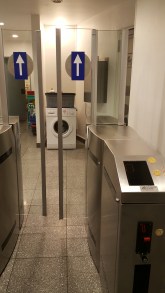
bathroom gate at Brussels Midi

Au revoir, Bruxelles — so nice to visit you again!

Au revoir, Mollie!

snapseed-kim and mollie 10-12-15

Amsterdam train platform

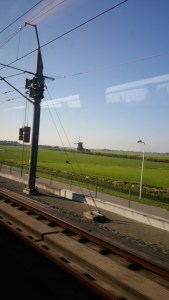
It was worth staying awake to watch the landscape go by and see what’s different about The Netherlands.

I saw farm land striped with water-filled drainage ditches, and cattle grazed between them. Like Flanders in Belgium, this is polder country, meaning the land is well below sea level. This is so for 26 percent of The Netherlands. Much farm land has been reclaimed from the sea through different methods, including the use of windmills to pump water.  (No wonder The Netherlands could offer expert assistance to the U.S. when New Orleans was flooded from Hurricane Katrina. This country knows how to hold back the sea.)

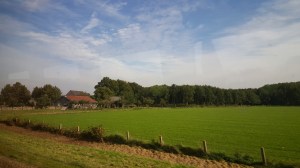
Dutch polder landscape copyFarmland en route to Amsterdam

Greenhouses and windfarm en route to Amsterdam

Greenhouses and windfarm

windmill in distance

Windmill in the distance

grafitti en route to amsterdam

Grafitti en route to Amsterdam

Street art en route to Amsterdam

Street art en route to Amsterdam

Train announcements were in French, Dutch, and English. About an hour into the trip, I heard, “Due to an individual  on the tracks, we will terminate this train.” This message was conveyed in a casual tone. Mollie told me this could happen.

train to amsterdam

I missed every announcement in English that followed because everyone started buzzing. I only knew we’d be changing trains. So, I followed the crowd. The two trains we switched to were packed. On the first one, those without seats sat on bags or stairs in the area between train cars until we changed trains again. Then, I managed to snag a seat and cram myself in with my bags. Once things were sorted out, we were about an hour behind schedule.

The bicycle culture revealed itself when we stopped in Rotterdam.
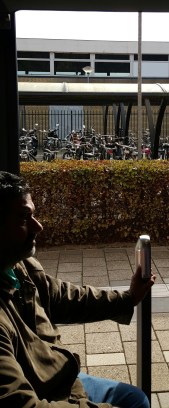
Bike rack en route to Amsterdam

Rotterdam – parked bicycles in background

Hallo, Amsterdam! Hoi!

Amsterdam Centraal Station

Centraal Station — grand, vast, and busy — was not generously equipped with restrooms. “Waar zijn de toiletten, alstublieft?” It was a hike to the “toiletten” and, again, you had to pay to “go.” Keep coins handy!

At the station, I located the tram my Airbnb host instructed me to take. Trams are priced in an interesting way. You can pay one price for unlimited rides for a set period of time. When I reached my stop, I had a nice, long walk to the apartment. I was wowed by what I saw of the city along the way. It was clearly different from Paris and Brussels.

As a pedestrian, you need to be extra-vigilant in stepping off sidewalks to cross cyclist lanes and streets. Intersections are regulated by lights specifically for each mode of travel — trams, cars, cyclists, and pedestrians. It’s a little complicated.

My head moved like a metronome every time I stepped off one path and onto another. Crossing a street sometimes meant going from one pavement island to another before reaching the pedestrian area. It was a gauntlet of sorts. This is not the place to walk with your eyes glued to your phone. Beware the bicycles and scooters, especially at rush hour!
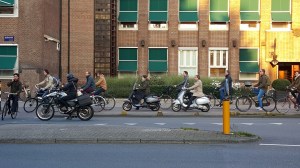
Amsterdam streets - cyclists scooters

Cyclists lane at rush hour

Cyclist in training - Amsterdam

Tiny cyclist-in-training

Road traffic - Amsterdam

Cyclists stop at traffic light

It seemed that canals and bridges were everywhere. For €16 — more than I paid for my Megabus from Paris to Brussels — I took a boat cruise to see the city at water level. The cruise was a little over an hour long. We went in and out of various canals, while the boat operator told us interesting things about the city and its architecture. Part of the cruise was on the Amstel River. I knew of the beer, but didn’t know it was named after a river.
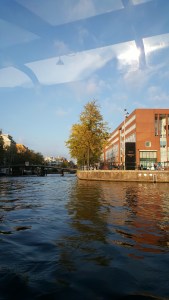
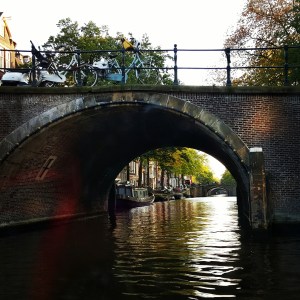
Amsterdam viewed from boatAmsterdam Canal - filter

From the boat, we saw the bike parking garage that holds 2,500 bikes. You can’t get “greener” than that! But, apparently, this is still not enough space for bicycle commuters and the city will have to create more parking.  No wonder car traffic was light.

Amsterdam Bike Garage

Bike parking garage on the right

Amsterdam is a very walkable city. There is a subway, but I never went underground. I traveled either on foot, boat, or tram. Next time, I’ll explore Amsterdam and the countryside by bike.

After three days, it was time to return to Paris. I’ve mentioned before the possibility of transit strikes. Had I not been paying attention to signs and cafe chatter, I would have been waiting in vain for a tram. The transit system planned a strike for the morning commute. To reach Centraal Station on time, I decided to walk to the Marriott Hotel where I knew I could get a cab. Cab fare was €18, more than the Megabus trip from Paris to Brussels. Just sayin’.

I’d made a reservation about a month in advance for the Thalys high-speed train to Paris.  (You may recall, this is the train on which a terrorist was thwarted from an attack by American servicemen.) The ticket cost €120. I thought this was a decent price until a local told me it was high. Here’s a tip:  make your reservations three months in advance and you’ll get a much better price. Wish I’d known this before.

Amsterdam Centraal - en route to ParisAmsterdam Centraal - train platform

Onward to Paris. I spent one final night there in a different neighborhood than I was in before. I spent a little time getting oriented so I could decide if I’d be comfortable taking Metro to the airport. After all, I’d have to walk to the station in the dark. Hmmm…would I pay €10 on Metro or 60€ for a cab?

I took Metro, of course.

Bonjour, Aer Lingus!  We meet again for the trip home.

Aer Lingus over Dublin

Aer Lingus jet landing in Dublin


Planes, Trains, and Vehicles – Getting Around Europe (Part 2)

Onward to Brussels!

I thought three weeks would be enough time to make a train reservation from Paris to Brussels. The cities are less than 200 miles apart and a high-speed train could get me there in an hour and a half. My plan was to arrive in Brussels early on Friday and leave for Amsterdam on Monday. My new friend, Mollie, was expecting me. Plus, I wanted to get there in time to check out Marolles Flea Market at Place Jeu de Balle.

Alas, travel by train was not to be. I scoured train schedules, and a 10:45 p.m. arrival on Friday was the best I could do. I was on the phone with my sister, Cheryl, as I waged battle with the Thalys reservation system; and then surrendered. She knew I was frustrated when we hung up. How else could I get from Paris to Brussels?  About a minute later, I had my answer. I was excited! I immediately called Cheryl to tell her I would be traveling by….

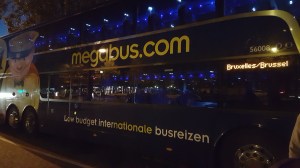
Megabus

Megabus! This is the same bus company I use to go to New York. It’s cheap and comfortable on the East Coast. And it’s really cheap and comfortable in Europe. My bus ticket from Paris to Brussels cost just under $13! For that price, I didn’t care that the ride would be three hours longer than the high-speed train. My Megabus was going to get me to Brussels by 12:20 pm!

Sweet!

Megabus departs from Porte Maillot, which is on the Metro line. The station is within sight of the Arc de Triomphe and the cars racing around L’Etoile.

Arc de Triomphe et L'Etoile

I left the apartment around 6 a.m. and walked along empty streets to the subway. It was still dark outside when I arrived at Porte Maillot. I didn’t know the lay of the land so I gave myself plenty of time to get lost. At Porte Maillot, I glommed onto another traveler, who was also looking for her bus. She was headed home to Germany on another cheap ride — FlixBus. Europeans really know how to get around, don’t they?

Au revoir, Paris! A bientôt!

The bus ride was relaxing, and I was able to sleep a bit. We had one 30 minute stop for water, snacks, and the restroom; otherwise, we went straight in to Brussels. I snapped photos of the scenery along the way.

The bus pulled into Brussels Nord (North) Station. I missed an opportunity to photograph the train station exterior because I was desperate to find le toilette. Durn! Now I need to return to Brussels someday to photograph the train station. Speaking of les toilettes, keep coins handy because a trip to a stall will cost you.

There wasn’t a lot of action at the train station when I arrived. Why? Train employees were on strike that day. Strikes are planned in advance and probably the reason why I couldn’t buy a ticket for a train that would get me to Brussels at a decent hour. No matter… I had discovered Megabus.

I took the flea market off the itinerary. I was starved and needed to meet up with Mollie. She’d given me instructions on how to reach her office building via Brussels Metro. The Metro is great, and includes subway and tram lines. Have I mentioned before that I love mass transit?

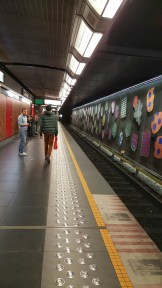
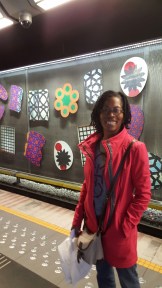
Brussels Metro stations have interesting artwork. I remembered that from when I was there in 2007. Photographing the art in all the Metro stations is another good reason to return to Belgium. (Every excuse will do.)

Metro station - BelgiumBelgian Metro station art

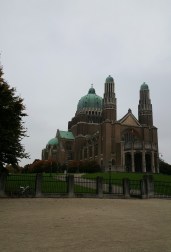
Although mass transit factored large in getting around cities, I’ll give a shout-out to walking as an underrated mode of transportation. Mollie and I enjoyed a long walk to National Basilica of the Sacred Heart. It’s popularly known as Koekelberg Basilica.

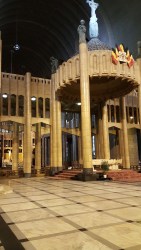
The Basilica is a marvel of Art Deco-style architecture, and it is the fifth largest church in the world. Construction started in the early 20th century, but was interrupted by two world wars. It finally opened in the 1970s.

Basilica - BrusselsBasilica interior 2Basilica interior - BrusselsBasilica exterior - Brussels

After visiting the stunning Basilica, we took Metro into the city.

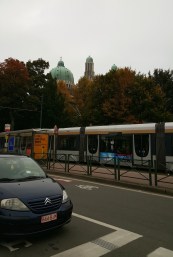
Metro stop with Basilica in background

Metro stop with Basilica in background

With Mollie in Brussels

Grand Place is an iconic Brussels site I wanted to see again. This town square is a UNESCO World Heritage Site. Its scale, compared to other town squares in Belgium, or elsewhere in Europe, is immense and majestic. Hotel de Ville (Town Hall), constructed in early to mid-15th century, is located there.

Hotel de Ville is surrounded by guild houses because tradesmen and merchants were held in high regard. Guild houses are sort of like trade unions in the U.S.  The great French writer, Victor Hugo, had a house on Grand Place as well.  You can find Grand Place in miniature, along with other iconic European Union structures, at Brussels’ Mini-Europe.

Day trips are incredibly easy from Brussels because of its three major train stations: Nord (North), Zuid (South), and Central (Central).  Back in 2007, my mother and I took day trips to Brugge, Antwerp, Ghent, Liege, Namur, and Tournai. Those cities, along with Brussels, are in six of 10 Belgian provinces and Brussels-Capital Region.

Mollie and I went to Brugge for the day. It’s a city in West Flanders province, popularly known by its French name, Bruges.  You can reach Brugge from Brussels in a little over an hour by train for about €30 roundtrip. Advance reservations aren’t necessary. (Tip: Check the website’s Stations and Trains page for a list of “Disturbances.” It will notify customers of strikes.)

Once in Brugge, you can rent a bike, take a boat ride, or walk. This small city is perfection.

Brussels is a wonderful destination in its own right. It is also a great base for day trips throughout Belgium. I highly recommend it!

Next … the finale of Getting Around Europe (Part 3).

Logo bigger final