
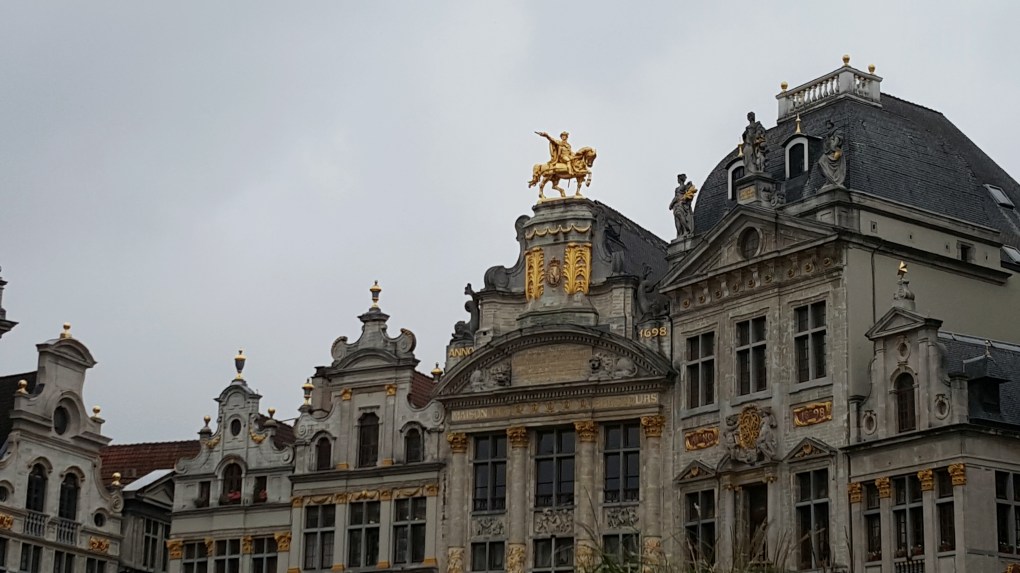
Belgians might sum up their country’s national identity by saying: “It’s complicated.”
This country appealed to me because of the cultural duality I saw in its tennis stars, Kim Clijsters and Justine Henin. They represented Belgium as Fed Cup teammates, but were not friends. These two tennis competitors mirrored their country’s competing regions. That bit of intrigue, and the fact that relatively few Americans travel there, is why I wanted to go.
I spent two weeks in Belgium in 2007; and three days there in 2015 with my local friend, Mollie. Even Belgians wanted to know “Why Belgium?” No one could understand how I could spend an entire two weeks in the country. To put it in perspective, Belgium is about the size of Maryland. I can’t imagine traveling in Maryland for two weeks and being as enthralled. So, what is it about Belgium?
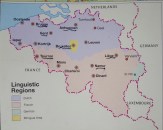
Map from Insight Guides – Belgium
I’ve seen Brussels described in news articles as a second-tier European capitol, which means the rest of the country is probably held in the same regard. Belgium’s cities, though, have been major financial centers throughout the centuries. For instance, in the 17th century, Ghent, in Flanders, was the second largest city in Europe after Paris. Liège, in Wallonia, was a major producer of steel during the Industrial Revolution. Now, the European Union (EU) is headquartered in Brussels, which is known as the Capital of the EU.


Did you know…
- Dutch-speaking Belgium is known as Flanders; and French-speaking Belgium is known as Wallonia. These two regions are culturally, economically, and politically different, and sometimes at odds with each other. Cultivating a single national identity is a challenge.
- Ancient cities, Tongeren and Tournai (in Flanders and Wallonia, respectively) were part of Roman Belgium (or Gallia Belgica) in 27 B.C. Earliest reference to Brussels is around 960 A.D., known then as “Bruocsella.”
- The “Flemish Painters” — Sir Peter Paul Rubens and Sir Anthony Van Dyck and others — flourished in the Baroque tradition in the 17th century. (Don’t confuse them, though, with the “Dutch Masters.” That group includes Vermeer and Rembrandt.) René Magritte was a famous Belgian surrealist of the 20th century.
- There is a saying about “meeting one’s Waterloo.” Waterloo, just south of Brussels, is where Napoleon finally got his little arse kicked by a combination of British, Dutch, and German forces back in 1815.
- Portions of what is now Belgium were controlled at different times by the Romans, the Spanish, and the French. Belgium was part of The United Kingdom of the Netherlands until 1830 when it gained independence (and its own monarchy) under King Leopold I. Though younger than the U.S. as a nation, some of Belgium’s cities and villages date back a millennium.
- Belgium is bordered by France, The Netherlands, Luxembourg, and Germany. Its official languages are French, Dutch, and German. Brussels is a mandated bilingual (French and Dutch) city and province.
- Belgium was invaded twice by Germany in World Wars I and II. The Second Battle of Ypres inspired the famous poem “In Flanders Fields.”
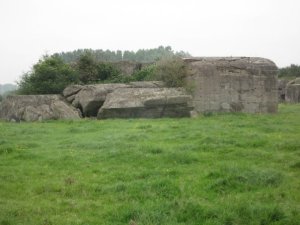
Remnants of German Bunker – Flanders

Poppies in a field – Flanders
- Belgium’s regions are mostly politically autonomous and the government is de-centralized. Amazingly, Belgium went 541 days without an elected government from 2009-11.
- Belgium currently has the third most robust economy in the EU.
- Flanders has a fierce lion on its flag; Wallonia has a cock (male rooster!) on its flag; and the national flag of Belgium is identical to the German flag in colors — the only difference being vertical versus horizontal stripes.
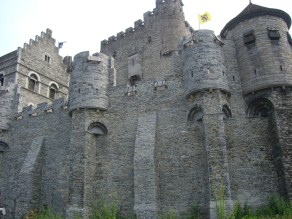
Gravensteen Castle – Ghent – Flemish flag above
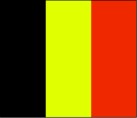

What is it about the Belgian brand? For food that has been exported world-wide, there’s Belgian endive, Belgian waffles, Brussels sprouts, Belgian chocolate, and Belgian beer and ale. People have made a pilgrimage to Belgium for the beer and ale alone.
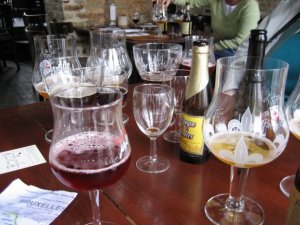
Beer-tasting in Flanders
Even some dog breeds rate a Belgian brand, like the Belgian shepherd, Bouvier des Flandres, and the very interesting-looking Griffon Bruxellois. Maybe, just maybe, a Belgian brand means Belgium has a national identity after all.
Belgium is a diverse country. When I was there in 2007, I was struck by the number of Muslims and Africans living there. In the 1860s, Belgium became a colonial power when it stole the Congo (now known as the Democratic Republic of Congo). The exploitation continued until the mid-1950s. Belgium also controlled a territory, formerly known as Ruanda-Urundi, and now known as the Independent Kingdoms of Rwanda and Burundi. Hence, the African populations in Belgium from the Congo, Rwanda, and Burundi.
I wondered when and why Muslims migrated to Belgium. In the 1960s, the first wave of migrants came from Morocco and Turkey. They were in Belgium on guest worker passes. Later, these migrants were followed by those from Algeria and Tunisia. Muslim populations in Brussels and Antwerp are comparable in size to those in Marseilles and Paris.
From my observations, North African Muslims and Africans did not appear to be thriving or part of mainstream Belgian society. I thought the same thing about Paris back in 1998, and recently in 2015. But, I was just passing through, so what did I know? Since then, I’ve learned my observations were on point. As an African-American, I have radar for this sort of thing.
What is it about Belgium? Why do people from these groups still come? Linguistically, Belgium works for native French and Dutch-speakers from anywhere in the world. And Belgium’s “balance sheet” is very much in the black. Migration generally occurs in the direction of opportunity. The question is whether everyone can partake in opportunities.
After the Brussels terrorist attacks on March 22, 2016, media outlets seemed to focus on Belgian authorities as being a bunch of boobs. That the Belgian government is mired in incompetence. That Brussels is an incubator for jihadists. That the EU is a failure when it comes to communicating intelligence to its member states. That Belgian nationals were among the Paris terrorists, and it’s Belgium’s fault because they were radicalized there. Any iota of sympathy for loss of lives and property in the Brussels attacks was overwhelmed by the recriminations.
What is it about Belgium? The public response toward Brussels was not like it was toward Paris when it was attacked in January and November 2015. Did someone press the mute button on the sympathy response? Where was the Belgian flag overlay for the Facebook profile photos? Some people think it’s because Belgium is not as well known as France.
Shortly after the Paris attacks, I wrote this piece. It applies to Belgium’s tragedy from jihadist attacks, too. Mollie was on her way to work when she was turned away at the Métro station and sent home. The Métro had already been attacked. In Mollie’s words, “the fear is palpable.” Belgium’s predicament has been ours, too. Terrorism occurs all over the world.
What is it about Belgium? Tiny and complicated though it is, Belgium is an historical treasure, and a major player in contemporary European politics. Without a doubt, Belgium and the EU have particular challenges. I’ll give Belgium a moment or two to regroup before I travel there again…and I certainly will.



 Wobblenot