
As you know by now, I love to plan my travel. This year, I traveled to Paris, and went from there to Brussels, then Amsterdam, and back to Paris. The European Union includes France, Belgium, and The Netherlands, making travel through open borders especially sweet. My only passport stamp, despite visiting three countries, was from France. That was in October 2015. Who knows how this may change since the November 13 attacks on Paris.
After terrorist events in 2001, the U.S. had a period of restricted air travel. Transit infrastructure was damaged and service suspended. A behemoth federal government department for all things security was created. We lived for years under daily Code Orange security threats. Worldwide, travelers now tack on more wait-time at airports due to robust security screening. Even though things changed immediately after 9/11, people are back in the skies, back on the trains, and they’ve accepted the new normal.
I’m betting on Paris to rebound like New York did. Parisiens will eventually get their joie de vivre back. If I only had more time from work and the money, I’d return there in a heartbeat. However things may change, don’t give up on any of these cities. I still highly recommend Paris, Brussels, and Amsterdam as beautiful, historical, and accessible destinations.
Getting to Paris
Google Flights was my first great discovery. This website was better for searching flights than all these subscriptions I had that were clogging up my email. Through Google Flights, I found my second great discovery: Aer Lingus, Ireland’s national airline. This airline had the best prices and travel times to Paris.
Sure, I could have paid a crazy cheap roundtrip fare on a particular new airline I will not name, but the flight would have arrived in Paris anywhere from 11-14 hours after I left Washington, D.C. I wanted savings in money and time. Maybe if I had all the time in the world, I wouldn’t care. This is what worked for me: a flight from D.C. to Dublin, short layover, and then a flight from Dublin to Paris. Aer Lingus gave the best bargain for price and flight time.
Another big plus for Aer Lingus is the flights were not over-sold and were all ON TIME. What??!!! (Now, I’m a fan.)

Aer Lingus Landing in Dublin
Getting from the Airport to the Apartment
When I arrived at Paris’ Charles de Gaulle Airport, I had some options for reaching my Airbnb apartment. A cab would have been more than 50€. Mass transit from the airport is an option at most major cities. I took the train from the airport and transferred to the subway. The apartment was near several subway stops. The cost? €10. Much better.
Using Paris Metro
The most economical thing was to buy Metro tickets in “bulk,” so I bought 10. I did this twice, and have a few tickets left over to give my sister when she travels there next year.

Three things I loved about using Paris Metro:
- The subway system has outstanding connectivity, especially when I compare it with some major transit systems in North America. I loved navigating the system and figuring out which route to take.

- Subway tunnel entertainment is a cut above the usual. I saw an opera singer, vibraphonist, and jazz singers. Parisians were blasé, but not I! I took a moment to check out this dramatic opera singer (lip syncher?) and give him a couple of euros. After all, I really was entertained. (Beware the volume for this one!)
- Subway station designs and visual art installations were wonderful.

Arts et Metiers Subway Station (Paris Metro)

Train at platform in Arts et Metiers Station

Champs-Elysees Clemenceau (Paris Metro)
Two things that were not lovable about using the subway in Paris:
- Wheelchair-bound or mobility-challenged people can’t use the subway. I only saw stairs everywhere. (If I’m mistaken, someone please tell me.)
- If you’ve overpacked your bags, you will not be happy pulling, carrying, or dragging that bulk up and down the stairs to get to your subway platform. My backpack and small bag were manageable, but that doesn’t mean I was happy when I had to carry them up a flight of stairs.
Although I didn’t do it, I also recommend using buses to get from Point A to Point B so you can have a surface-level view of the city. It adds something to the transportation experience. But, I walked…a lot. I wish I’d known about the fitness app that was already on my Smartphone so I could have tracked my steps!
Day Trips
Europe has an awesome rail network. Paris has seven train stations, including the one at Charles de Gaulle Airport. Day trips are easy to do. Check out the train schedules to various destinations and figure out how much time you want to commit to traveling somewhere just for the day. I have a book, Day Trips – France, that counts Lyon as a day trip. Lyon is 288 miles from Paris, but those miles fly by when you’re on a high speed train. The cost is variable, depending on when you buy your ticket, and the trip is two hours each way.
I wanted to make good use of my days, wherever I would decide to go. I chose Chartres and we caught the train from Gare Montparnasse. Chartres is a little over an hour from Paris by train, and the schedule gave us plenty of options. The cost: €30roundtrip. I’d been to Chartres before, but felt like I hadn’t spent time in the city. This time, I hung out in Chartres with my new local friend, Charlotte.

Chartres is best known for its Cathedrale Notre Dame de Chartres. It is on the list of UNESCO World Heritage sites and is a magnificent example of Gothic architecture. You can see it from anywhere in the city. Notice the Cathedral’s distinctive, mismatched towers.
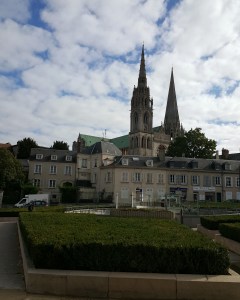
How could a city of 40,000 support such a massive cathedral? Chartres belongs to the faithful world-wide and those who want to marvel at its architecture and original stained glass. There have been pilgrimages to Chartres Cathedral since the early Middle Ages. It is on a pilgrimage route called Chemin de Saint-Jacques de Compostelle (Way of St. James). The Spanish portion of the route is known as the Camino de Santiago.

Charlotte wandered off while I took a tour of the Cathedral. There was scaffolding in places for the long-term restoration, including cleaning grime from the stone. Despite this, the Cathedral inspired awe and wonder.


After the Cathedral, I finally saw a bit more of Chartres. Leisure was the theme of the day. We had lunch at one cafe, explored shops and streets, and then stopped at another cafe for dessert and people-watching.


Our only time constraints were train arrival and departure times. In the hours in between, we hung out and enjoyed Chartres on a beautiful day!
Stay tuned for Planes, Trains, and Vehicles: Getting Around Europe (Part 2).




 Wobblenot